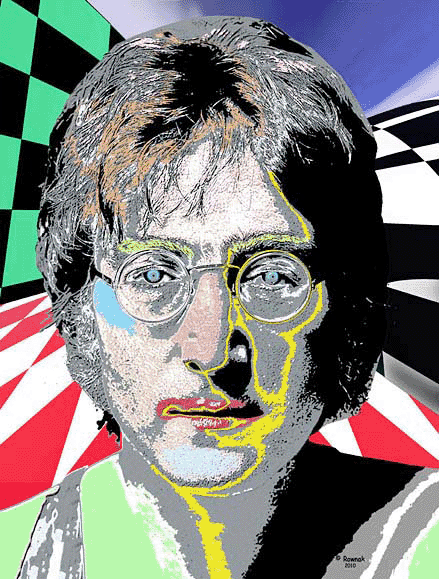
Pop
star, composer, songwriter, and recording artist. John Winston Lennon
was born October 9, 1940, in Liverpool, Merseyside, NW England, UK,
during a German air raid in World War II.
When
he was four years old, Lennon's parents separated and he ended up
living with his Aunt Mimi. John's father was a merchant seaman. He
was not present at his son's birth and did not see a lot of his son
when he was small.
Lennon's
mother, Julia, remarried, but visited John and Mimi regularly. She
taught John how to play the banjo and the piano and purchased his
first guitar. John was devastated when Julia was fatally struck by
a car driven by an off-duty police officer in July 1958. Her death
was one of the most traumatic events in his life.
As
a child, John was a prankster and he enjoyed getting in trouble. As
a boy and young adult, John enjoyed drawing grotesque figures and
cripples. John's school master thought that he could go to an art
school for college, since he did not get good grades in school, but
had artistic talent.
At
sixteen, Elvis Presley's explosion onto the rock music scene inspired
John to create the skiffle band called the "Quarry Men,"
named after his school. Lennon met Paul McCartney at a church fete
on July 6, 1957. John soon invited Paul to join the group and they
eventually formed the most successful songwriting partnership in musical
history.
McCartney
introduced George Harrison to Lennon the following year and he and
art college buddy Stuart Sutcliffe also joined Lennon's band. Always
in need of a drummer, the group finally settled on Pete Best in 1960.
The
first recording they made was Buddy Holly's That'll be the Day in
mid-1958. In fact, it was Holly's group, the Crickets, that inspired
the band to change its name. John would later joke that he had a vision
when he was 12 years old—a man appeared on a flaming pie and
said unto them "from this day on you are Beatles with an 'A.'"
The
Beatles were discovered by Brian Epstein in 1961 at the Cavern Club,
where they were performing on a regular basis. As their new manager,
Epstein secured a record contract with EMI. With a new drummer, Ringo
Starr (Richard Starkey), and George Martin as producer, the group
released their first single, Love Me Do in October 1962. It peaked
on the British charts at number 17.
Lennon
wrote the group's follow-up single, Please Please Me, inspired primarily
by Roy Orbison but also fed by John's infatuation with the pun in
Bing Crosby's famous "Please, lend your little ears to my please."
The song topped the charts in Britain. The Beatles went on to become
the most popular band in Britain with the release mega-hits like She
Loves You and I Want To Hold Your Hand.
In
1964, The Beatles became the first band to break out big in the United
States, beginning with their appearance on TV's The Ed Sullivan Show
on February 9, 1964. Beatlemania launched a "British Invasion"'
of rock bands into the U.S., which included The Rolling Stones and
The Kinks. After 'Sullivan,' The Beatles returned to Britain to film
their first movie, A Hard Day's Night and prepare for their first
world tour.
The Beatles followed up with their second movie Help! in 1965. In June,
the Queen of England had announced that the Beatles would be awarded
the MBE (Member of the Order of the British Empire). In August, they
performed to 55,600 fans at New York's Shea Stadium, setting a record
for largest concert audience. When they returned to England, they recorded
the breakthrough album Rubber Soul, which extended beyond love songs
and pop formulas.
The
magic of Beatlemania had started to lose its appeal by 1966. The group's
lives were put in danger when they were accused of snubbing the presidential
family in the Philippines. Then, Lennon's remark that "we're
more popular than Jesus now" incited denunciations and Beatles
record bonfires in the U.S. bible belt. The Beatles gave up touring
after an August 29, 1966, concert at San Francisco's Candlestick Park.
After
an extended break, the band returned to the studio to expand their
experimental with drug-influenced exotic instrumentation/lyrics and
tape abstractions. The first sample was the single Penny Lane/Strawberry
Fields Forever, followed up by Sgt. Pepper's Lonely Hearts Club Band,
still considered by many to be the greatest rock album ever.
The
Beatles then suffered a huge blow when Epstein died of an accidental
overdose of sleeping pills on August 27, 1967. Shaken by Epstein's
death, the Beatles retrenched under McCartney's leadership in the
fall and filmed Magical Mystery Tour. While the film was panned by
critics, the soundtrack album contained Lennon's I Am The Walrus,
their most cryptic work yet.
After
the Magical Mystery Tour film failed, the Beatles retreated into Transcendental
Meditation and the Maharishi Mahesh Yogi, which took them to India
for two months in early 1968. Their next effort, Apple Corps Ltd.
was plagued by mismanagement. In July, the group faced its last hysterical
crowds at the premiere of their film Yellow Submarine. In November,
their double-album The Beatles (frequently called the White Album)
showed their divergent directions.
Lennon
had married Cynthia Powell in August 1962 and they had a son together
who they called Julian, named after John's mother. Cynthia had to
keep a very low profile during Beatlemania. They divorced in 1968
and he re-married Japanese avant-garde artist Yoko Ono, whom he had
met at the Indica Gallery in November 1966.
John
and Yoko's artist partnership began to cause further tensions within
the group. Together they invented a form of peace protest by staying
in bed while being filmed and interviewed, and the single recorded
under the name of The Plastic Ono Band, Give Peace a Chance (1969),
became the national anthem for pacifists.
Lennon
left The Beatles in September 1969, just after the group completed
recording Abbey Road. The news of the breakup was kept secret until
McCartney announced his departure in April 1970, a month before the
band released Let It Be, recorded just before Abbey Road.
After the Beatles broke up, Lennon released Plastic Ono Band, with a
raw, minimalist sound that followed "primal-scream" therapy.
In 1971, he followed up with Imagine, the most commercially successful
and critically acclaimed of all John Lennon's post-Beatles efforts.
The title track was later listed as the third all-time best song by
Rolling Stone magazine.
Peace
and love, however, was not always on Lennon's agenda. Imagine also
included the track How Do You Sleep?, a nasty response to veiled messages
at Lennon in some of McCartney's solo recordings. Later, the former
songwriting duo buried the hatchet, but never formally worked together
again.
Lennon
and Ono moved to the U.S. in September 1971, but were constantly threatened
with deportation by the Nixon administration. Lennon was told he was
being kicked out of the country because of his 1968 marijuana conviction
in Britain. But Lennon believed the true reason was his activism against
the unpopular Vietnam War. Documents later proved him correct. Two
years after Nixon resigned, Lennon was granted permanent U.S. residency
in 1976.
In
1972, Lennon performed at Madison Square Garden to benefit mentally
handicapped children and continued to promote peace while battling
to stay in the U.S. That immigration battle took a toll on the Lennon's
marriage and in the fall of 1973, they separated. John went to Los
Angeles, where he partied and took a mistress, May Pang. He still
managed to release hit albums, such as Mind Games, Walls and Bridges
and Rock and Roll and collaborate with David Bowie and Elton John.
In
the end, Lennon realized he really loved Yoko and he could not live
without her. They reconciled and she gave birth to their only child,
Sean, on Lennon's 35th birthday. John decided to leave the music business
to raise his son and become a house husband.
In
1980, Lennon returned to the music world with the album Double Fantasy,
featuring the hit single (Just Like) Starting Over. Unfortunately,
just a few weeks after its release, Lennon was shot by a deranged
fan in front of his apartment complex in New York. Lennon died of
the age of 40 at the Roosevelt Hospital on December 8, 1980, after
receiving multiple gun shots in the back.
His
death affected millions of people, record sales soared, and he continues
to be admired by new generations of fans.
Visit
our special JOHN LENNON Tribute Site for photo gallery, timeline,
and more.
©
2009 A&E Television Networks. All rights reserved.
|
George Washington Biography
byname Father of His Country
( 1732 – 1799 )
(born
February 22 [February 11, Old Style], 1732, Westmoreland county, Virginia
[U.S.]—died December 14, 1799, Mount Vernon, Virginia, U.S.)
American general and commander in chief of the colonial armies in
the American Revolution (1775–83) and subsequently first president
of the United States (1789–97). (For a discussion of the history
and nature of the presidency, presidency of the United States of America.)
Washington's
father, Augustine Washington, had gone to school in England, had tasted
seafaring life, and then settled down to manage his growing Virginia
estates. His mother was Mary Ball, whom Augustine, a widower, had
married early the previous year. Washington's paternal lineage had
some distinction; an early forebear was described as a “gentleman,”
Henry VIII later gave the family lands, and its members held various
offices. But family fortunes fell with the Puritan revolution in England,
and John Washington, grandfather of Augustine, migrated in 1657 to
Virginia. The ancestral home at Sulgrave, Northamptonshire, is maintained
as a Washington memorial. Little definite information exists on any
of the line until Augustine. He was an energetic, ambitious man who
acquired much land, built mills, took an interest in opening iron
mines, and sent his two oldest sons to England for schooling. By his
first wife, Jane Butler, he had four children; by his second wife,
Mary Ball, he had six. Augustine died April 12, 1743.
Childhood
and youth
Little
is known of George Washington's early childhood, spent largely on
the Ferry Farm on the Rappahannock River, opposite Fredericksburg,
Virginia. Mason L. Weems's stories of the hatchet and cherry tree
and of young Washington's repugnance to fighting are apocryphal efforts
to fill a manifest gap. He attended school irregularly from his 7th
to his 15th year, first with the local church sexton and later with
a schoolmaster named Williams. Some of his schoolboy papers survive.
He was fairly well trained in practical mathematics—gauging,
several types of mensuration, and such trigonometry as was useful
in surveying. He studied geography, possibly had a little Latin, and
certainly read some of The Spectator and other English classics.
The copybook in which he transcribed at 14 a set of moral precepts,
or Rules of Civility and Decent Behaviour in Company and Conversation,
was carefully preserved. His best training, however, was given him
by practical men and outdoor occupations, not by books. He mastered
tobacco growing and stock raising, and early in his teens he was sufficiently
familiar with surveying to plot the fields about him.
At
his father's death, the 11-year-old boy became the ward of his eldest
half brother, Lawrence, a man of fine character who gave him wise
and affectionate care. Lawrence inherited the beautiful estate of
Little Hunting Creek, which had been granted to the original settler,
John Washington, and which Augustine had done much since 1738 to develop.
Lawrence married Anne (Nancy) Fairfax, daughter of Colonel William
Fairfax, a cousin and agent of Lord Fairfax and one of the chief proprietors
of the region. Lawrence also built a house and named the 2,500-acre
(1,000-hectare) holding Mount Vernon in honour of the admiral under
whom he had served in the siege of Cartagena. Living there chiefly
with Lawrence (though he spent some time near Fredericksburg with
his other half brother, Augustine, called Austin), George entered
a more spacious and polite world. Anne Fairfax Washington was a woman
of charm, grace, and culture; Lawrence had brought from his English
school and naval service much knowledge and experience. A valued neighbour
and relative, George William Fairfax, whose large estate, Belvoir,
was about 4 miles (6 km) distant, and other relatives by marriage,
the Carlyles of Alexandria, helped form George's mind and manners.
The youth turned first to surveying as a profession. Lord Fairfax,
a middle-aged bachelor who owned more than 5,000,000 acres (2,000,000
hectares) in northern Virginia and the Shenandoah Valley, came to
America in 1746 to live with his cousin George William at Belvoir
and to look after his properties. Two years later he sent to the Shenandoah
Valley a party to survey and plot his lands to make regular tenants
of the squatters moving in from Pennsylvania. With the official surveyor
of Prince William county in charge, Washington went along as assistant.
The 16-year-old lad kept a disjointed diary of the trip, which shows
skill in observation. He describes the discomfort of sleeping under
“one thread Bear blanket with double its Weight of Vermin such
as Lice Fleas & c”; an encounter with an Indian war party
bearing a scalp; the Pennsylvania-German emigrants, “as ignorant
a set of people as the Indians they would never speak English but
when spoken to they speak all Dutch”; and the serving of roast
wild turkey on “a Large Chip,” for “as for dishes we
had none.”
The
following year (1749), aided by Lord Fairfax, Washington received
an appointment as official surveyor of Culpeper county, and for more
than two years he was kept almost constantly busy. Surveying not only
in Culpeper but also in Frederick and Augusta counties, he made journeys
far beyond the Tidewater region into the western wilderness. The experience
taught him resourcefulness and endurance and toughened him in both
body and mind. Coupled with Lawrence's ventures in land, it also gave
him an interest in western development that endured throughout his
life. He was always disposed to speculate in western holdings and
to view favourably projects for colonizing the West, and he greatly
resented the limitations that the crown in time laid on the westward
movement. In 1752 Lord Fairfax determined to take up his final residence
in the Shenandoah Valley and settled there in a log hunting lodge,
which he called Greenway Court after a Kentish manor of his family's.
There Washington was sometimes entertained and had access to a small
library that Fairfax had begun accumulating at Oxford.
The
years 1751–52 marked a turning point in Washington's life, for
they placed him in control of Mount Vernon. Lawrence, stricken by
tuberculosis, went to Barbados in 1751 for his health, taking George
along. From this sole journey beyond the present borders of the United
States, Washington returned with the light scars of an attack of smallpox.
In July of the next year, Lawrence died, making George executor and
residuary heir of his estate should his daughter, Sarah, die without
issue. As she died within two months, Washington at age 20 became
head of one of the best Virginia estates. He always thought farming
the “most delectable” of pursuits. “It is honorable,”
he wrote, “it is amusing, and, with superior judgment, it is
profitable.” And, of all the spots for farming, he thought Mount
Vernon the best. “No estate in United America,” he assured
an English correspondent, “is more pleasantly situated than this.”
His greatest pride in later days was to be regarded as the first farmer
of the land.
He gradually increased the estate until it exceeded 8,000 acres (3,000
hectares). He enlarged the house in 1760 and made further enlargements
and improvements on the house and its landscaping in 1784–86.
He also tried to keep abreast of the latest scientific advances.
For
the next 20 years the main background of Washington's life was the
work and society of Mount Vernon. He gave assiduous attention to the
rotation of crops, fertilization of the soil, and the management of
livestock. He had to manage the 18 slaves that came with the estate
and others he bought later; by 1760 he had paid taxes on 49 slaves—though
he strongly disapproved of the institution and hoped for some mode
of abolishing it. At the time of his death, more than 300 slaves were
housed in the quarters on his property. He had been unwilling to sell
slaves lest families be broken up, even though the increase in their
numbers placed a burden on him for their upkeep and gave him a larger
force of workers than he required, especially after he gave up the
cultivation of tobacco. In his will, he bequeathed the slaves in his
possession to his wife and ordered that upon her death they be set
free, declaring also that the young, the aged, and the infirm among
them “shall be comfortably cloathed & fed by my heirs.”
Still, this accounted for only about half the slaves on his property.
The other half, owned by his wife, were entailed to the Custis estate,
so that on her death they were destined to pass to her heirs. However,
she freed all the slaves in 1800 after his death.
For
diversion Washington was fond of riding, fox hunting, and dancing,
of such theatrical performances as he could reach, and of duck hunting
and sturgeon fishing. He liked billiards and cards and not only subscribed
to racing associations but also ran his own horses in races. In all
outdoor pursuits, from wrestling to colt breaking, he excelled. A
friend of the 1750s describes him as “straight as an Indian,
measuring six feet two inches in his stockings”; as very muscular
and broad-shouldered but, though large-boned, weighing only 175 pounds;
and as having long arms and legs. His penetrating blue-gray eyes were
overhung by heavy brows, his nose was large and straight, and his
mouth was large and firmly closed. “His movements and gestures
are graceful, his walk majestic, and he is a splendid horseman.”
He soon became prominent in community affairs, was an active member
and later vestryman of the Episcopal church, and as early as 1755
expressed a desire to stand for the Virginia House of Burgesses.
Prerevolutionary
military and political career
Early military career
Traditions of John Washington's feats as Indian fighter and Lawrence
Washington's talk of service days helped imbue George with military
ambition. Just after Lawrence's death, Lieutenant Governor Robert
Dinwiddie appointed George adjutant for the southern district of Virginia
at £100 a year (November 1752). In 1753 he became adjutant of
the Northern Neck and Eastern Shore. Later that year, Dinwiddie found
it necessary to warn the French to desist from their encroachments
on Ohio Valley lands claimed by the crown. After sending one messenger
who failed to reach the goal, he determined to dispatch Washington.
On the day he received his orders, October 31, 1753, Washington set
out for the French posts. His party consisted of a Dutchman to serve
as interpreter, the expert scout Christopher Gist as guide, and four
others, two of them experienced traders with the Indians. Theoretically,
Great Britain and France were at peace. Actually, war impended, and
Dinwiddie's message was an ultimatum: the French must get out or be
put out.
The journey proved rough, perilous, and futile. Washington's party
left what is now Cumberland, Maryland, in the middle of November and,
despite wintry weather and impediments of the wilderness, reached
Fort LeBoeuf, at what is now Waterford, Pennsylvania, 20 miles (32
km) south of Lake Erie, without delay. The French commander was courteous
but adamant. As Washington reported, his officers “told me,
That it was their absolute Design to take possession of the Ohio,
and by God they would do it.” Eager to carry this alarming news
back, Washington pushed off hurriedly with Gist. He was lucky to have
gotten back alive. An Indian fired at them at 15 paces but missed.
When they crossed the Allegheny River on a raft, Washington was jerked
into the ice-filled stream but saved himself by catching one of the
timbers. That night he almost froze in his wet clothing. He reached
Williamsburg, Virginia, on January 16, 1754, where he hastily penned
a record of the journey. Dinwiddie, who was labouring to convince
the crown of the seriousness of the French threat, had it printed,
and when he sent it to London, it was reprinted in three different
forms.
The
enterprising governor forthwith planned an expedition to hold the
Ohio country. He made Joshua Fry colonel of a provincial regiment,
appointed Washington lieutenant colonel, and set them to recruiting
troops. Two agents of the Ohio Company, which Lawrence Washington
and others had formed to develop lands on the upper Potomac and Ohio
rivers, had begun building a fort at what later became Pittsburgh,
Pennsylvania. Dinwiddie, ready to launch into his own war, sent Washington
with two companies to reinforce this post. In April 1754 the lieutenant
colonel set out from Alexandria with about 160 men at his back. He
marched to Cumberland only to learn that the French had anticipated
the British blow; they had taken possession of the fort of the Ohio
Company and had renamed it Fort Duquesne. Happily, the Indians of
the area offered support. Washington therefore struggled cautiously
forward to within about 40 miles (60 km) of the French position and
erected his own post at Great Meadows, near what is now Confluence,
Pennsylvania. From this base, he made a surprise attack (May 28, 1754)
upon an advance detachment of 30 French, killing the commander, Coulon
de Jumonville, and nine others and taking the rest prisoners. The
French and Indian War had begun.
Washington
at once received promotion to a full colonelcy and was reinforced,
commanding a considerable body of Virginia and North Carolina troops,
with Indian auxiliaries. But his attack soon brought the whole French
force down upon him. They drove his 350 men into the Great Meadows
fort (Fort Necessity) on July 3, besieged it with 700 men, and, after
an all-day fight, compelled him to surrender. The construction of
the fort had been a blunder, for it lay in a waterlogged creek bottom,
was commanded on three sides by forested elevations approaching it
closely, and was too far from Washington's supports. The French agreed
to let the disarmed colonials march back to Virginia with the honours
of war, but they compelled Washington to promise that Virginia would
not build another fort on the Ohio for a year and to sign a paper
acknowledging responsibility for “ l'assassinat” of de
Jumonville, a word that Washington later explained he did not rightly
understand. He returned to Virginia, chagrined but proud, to receive
the thanks of the House of Burgesses and to find that his name had
been mentioned in the London gazettes. His remark in a letter to his
brother that “I have heard the bullets whistle; and believe
me, there is something charming in the sound” was commented
on humorously by the author Horace Walpole and sarcastically by King
George II.
The arrival of General Edward Braddock and his army in Virginia in
February 1755, as part of the triple plan of campaign that called
for his advance on Fort Duquesne and in New York Governor William
Shirley's capture of Fort Niagara and Sir William Johnson's capture
of Crown Point, brought Washington new opportunities and responsibilities.
He had resigned his commission in October 1754 in resentment of the
slighting treatment and underpayment of colonial officers and particularly
because of an untactful order of the British war office that provincial
officers of whatever rank would be subordinate to any officer holding
the king's commission. But he ardently desired a part in the war;
“my inclinations,” he wrote a friend, “are strongly
bent to arms.” When Braddock showed appreciation of his merits
and invited him to join the expedition as personal aide-de-camp, with
the courtesy title of colonel, he therefore accepted. His self-reliance,
decision, and masterfulness soon became apparent.
At
table he had frequent disputes with Braddock, who, when contractors
failed to deliver their supplies, attacked the colonials as supine
and dishonest while Washington defended them warmly. His freedom of
utterance is proof of Braddock's esteem. Braddock accepted Washington's
unwise advice that he divide his army, leaving half of it to come
up with the slow wagons and cattle train and taking the other half
forward against Fort Duquesne at a rapid pace. Washington was ill
with fever during June but joined the advance guard in a covered wagon
on July 8, begged to lead the march on Fort Duquesne with his Virginians
and Indian allies, and was by Braddock's side when on July 9 the army
was ambushed and bloodily defeated.
In
this defeat Washington displayed the combination of coolness and determination,
the alliance of unconquerable energy with complete poise, that was
the secret of so many of his successes. So ill that he had to use
a pillow instead of a saddle and that Braddock ordered his body servant
to keep special watch over him, Washington was, nevertheless, everywhere
at once. At first he followed Braddock as the general bravely tried
to rally his men to push either forward or backward, the wisest course
the circumstances permitted. Then he rode back to bring up the Virginians
from the rear and rallied them with effect on the flank. To him was
largely due the escape of the force. His exposure of his person was
as reckless as Braddock's, who was fatally wounded on his fifth horse;
Washington had two horses shot out from under him and his clothes
cut by four bullets without being hurt. He was at Braddock's deathbed,
helped bring the troops back, and was repaid by being appointed, in
August 1755, while still only 23 years old, commander of all Virginia
troops.
But
no part of his later service was conspicuous. Finding that a Maryland
captain who held a royal commission would not obey him, he rode north
in February 1756 to Boston to have the question settled by the commander
in chief in America, Governor Shirley, and, bearing a letter from
Dinwiddie, had no difficulty in carrying his point. On his return
he plunged into a multitude of vexations. He had to protect a weak,
thinly settled frontier nearly 400 miles (650 km) in length with only
some 700 ill-disciplined colonial troops, to cope with a legislature
unwilling to support him, to meet attacks on the drunkenness and inefficiency
of the soldiers, and to endure constant wilderness hardships. It is
not strange that in 1757 his health failed and in the closing weeks
of that year he was so ill of a “bloody flux” (dysentery)
that his physician ordered him home to Mount Vernon.
In the spring of 1758 he had recovered sufficiently to return to duty
as colonel in command of all Virginia troops. As part of the grand
sweep of several armies organized by British statesman William Pitt,
the Elder, General John Forbes led a new advance upon Fort Duquesne.
Forbes resolved not to use Braddock's road but to cut a new one west
from Raystown, Pennsylvania. Washington disapproved of the route but
played an important part in the movement. Late in the autumn the French
evacuated and burned Fort Duquesne, and Forbes reared Fort Pitt on
the site. Washington, who had just been elected to the House of Burgesses,
was able to resign with the honorary rank of brigadier general.
Although
his officers expressed regret at the “loss of such an excellent
Commander, such a sincere Friend, and so affable a Companion,”
he quit the service with a sense of frustration. He had thought the
war excessively slow. The Virginia legislature had been niggardly
in voting money; the Virginia recruits had come forward reluctantly
and had proved of poor quality—Washington had hanged a few deserters
and flogged others heavily. Virginia gave him less pay than other
colonies offered their troops. Desiring a regular commission such
as his half brother Lawrence had held, he applied in vain to the British
commander in North America, Lord Loudoun, to make good a promise that
Braddock had given him. Ambitious for both rank and honour, he showed
a somewhat strident vigour in asserting his desires and in complaining
when they were denied. He returned to Mount Vernon somewhat disillusioned.
Marriage
and plantation life
Immediately on resigning his commission, Washington was married (January
6, 1759) to Martha Dandridge, the widow of Daniel Parke Custis. She
was a few months older than he, was the mother of two children living
and two dead, and possessed one of the considerable fortunes of Virginia.
Washington had met her the previous March and had asked for her hand
before his campaign with Forbes. Though it does not seem to have been
a romantic love match, the marriage united two harmonious temperaments
and proved happy. Martha was a good housewife, an amiable companion,
and a dignified hostess. Like many well-born women of the era, she
had little formal schooling, and Washington often helped her compose
important letters.
Some
estimates of the property brought to him by this marriage have been
exaggerated, but it did include a number of slaves and about 15,000
acres (6,000 hectares), much of it valuable for its proximity to Williamsburg.
More important to Washington were the two stepchildren, John Parke
(“Jacky”) and Martha Parke (“Patsy”) Custis,
who at the time of the marriage were six and four, respectively. He
lavished great affection and care upon them, worried greatly over
Jacky's waywardness, and was overcome with grief when Patsy died just
before the Revolution. Jacky died during the war, leaving four children.
Washington adopted two of them, a boy and a girl, and even signed
his letters to the boy as “your papa.” Himself childless,
he thus had a real family.
From the time of his marriage Washington added to the care of Mount
Vernon the supervision of the Custis estate at the White House on
the York River. As his holdings expanded, they were divided into farms,
each under its own overseer; but he minutely inspected operations
every day and according to one visitor often pulled off his coat and
performed ordinary labour. As he once wrote, “middling land
under a man's own eyes, is more profitable than rich land at a distance.”
Until the eve of the Revolution he devoted himself to the duties and
pleasures of a great landholder, varied by several weeks' attendance
every year in the House of Burgesses in Williamsburg. During 1760–74
he was also a justice of the peace for Fairfax county, sitting in
court in Alexandria.
In
no light does Washington appear more characteristically than as one
of the richest, largest, and most industrious of Virginia planters.
For six days a week he rose early and worked hard; on Sundays he irregularly
attended Pohick Church (16 times in 1760), entertained company, wrote
letters, made purchases and sales, and sometimes went fox hunting.
In these years he took snuff and smoked a pipe; throughout life he
liked Madeira wine and punch. Although wheat and tobacco were his
staples, he practiced crop rotation on a three-year or five-year plan.
He had his own water-powered flour mill, blacksmith shop, brick and
charcoal kilns, carpenters, and masons. His fishery supplied shad,
bass, herring, and other catches, salted as food for his slaves. Coopers,
weavers, and his own shoemaker turned out barrels, cotton, linen,
and woollen goods, and brogans for all needs. In short, his estates,
in accordance with his orders to overseers to “buy nothing you
can make yourselves,” were largely self-sufficient communities.
But he did send large orders to England for farm implements, tools,
paint, fine textiles, hardware, and agricultural books and hence was
painfully aware of British commercial restrictions.
Washington
was an innovative farmer and a responsible landowner. He experimented
at breeding cattle, acquired at least one buffalo, with the hope of
proving its utility as a meat animal, and kept stallions at stud.
He also took pride in a peach and apple orchard.
His
care of slaves was exemplary. He carefully clothed and fed them, engaged
a doctor for them by the year, generally refused to sell them—“I
am principled against this kind of traffic in the human species”—and
administered correction mildly. They showed so much attachment that
few ran away.
He
meanwhile played a prominent role in the social life of the Tidewater
region. The members of the council and House of Burgesses, a roster
of influential Virginians, were all friends. He visited the Byrds
of Westover, the Lees of Stratford, the Carters of Shirley and Sabine
Hall, and the Lewises of Warner Hall; Mount Vernon often was busy
with guests in return. He liked house parties and afternoon tea on
the Mount Vernon porch overlooking the grand Potomac; he was fond
of picnics, barbecues, and clambakes; and throughout life he enjoyed
dancing, frequently going to Alexandria for balls. Cards were a steady
diversion, and his accounts record sums lost at them, the largest
reaching nearly £10. His diary sometimes states that in bad
weather he was “at home all day, over cards.” Billiards
was a rival amusement. Not only the theatre, when available, but also
concerts, cockfights, circuses, puppet shows, and exhibitions of animals
received his patronage.
More
© 1996-2010 A&E Television Networks. All Rights Reserved
|